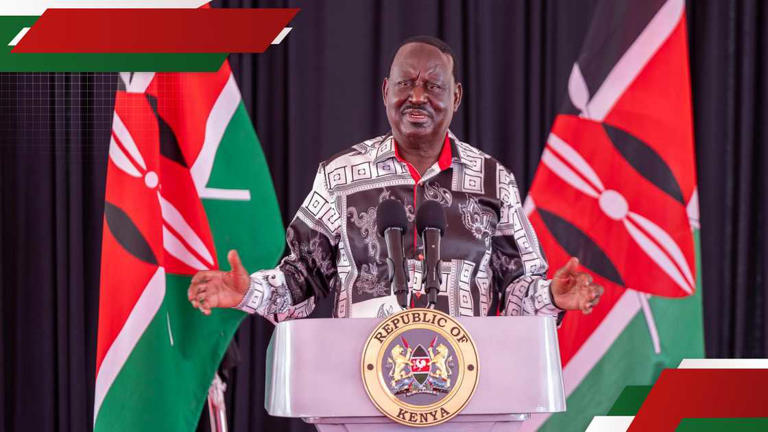
The internal struggle within the Orange Democratic Movement (ODM) following the death of Raila Odinga has produced a number of political flashpoints, but few figures have come to embody the contest over the party’s future as clearly as Edwin Watenya Sifuna. The attempted dismissal of Sifuna from his position as ODM Secretary-General subsequently suspended by a court order has not only intensified factional tensions within the party but also transformed Sifuna into a symbolic figure within Kenya’s evolving opposition politics.
At present, ODM appears divided into two broad camps. One faction is associated with Oburu Oginga and leaders such as Gladys Wanga and Junet Mohamed, who are perceived as favouring pragmatic engagement with the government of President William Kipchirchir Samoei Ruto, particularly within the framework of the emerging “broad-based” political arrangement. The opposing camp, represented by Sifuna and allied figures such as s James Orengo, Godfrey Osotsi, and Embakasi East MP, Paul (Babu) Owino. This group positions itself as the custodian of ODM’s traditional opposition identity, emphasising institutional independence, constitutionalism, and resistance to what it perceives as the gradual co-optation of the party into the orbit of the ruling administration. The rivalry between these two camps has manifested publicly through competing political mobilisations, including the “Linda Ground” rallies and the “Linda Mwananchi” gatherings. These events illustrate a deeper struggle over leadership, ideological direction, and the party’s strategic positioning ahead of the 2027 general election.
But to understand why Sifuna has become central to this struggle, it is necessary to examine who he is, how he rose within ODM, and what his political positioning means for Kenya’s opposition politics.
Who is Edwin Watenya Sifuna?
Edwin Watenya Sifuna is a Kenyan lawyer, politician, and the Senator for Nairobi County, one of the most politically influential constituencies in the country. He first gained national prominence through his role as a communications strategist and spokesperson within the Orange Democratic Movement (ODM), where his confrontational media style and strong defense of party positions made him one of the party’s most recognizable public voices. His election as Nairobi Senator further elevated his national profile, giving him both legislative authority and a major urban political base within Kenya’s capital.
Born in Kakamega County in Western Kenya, Sifuna trained as a lawyer before entering national politics. His early public visibility emerged during his work as a political spokesperson and communications strategist within ODM, where he developed a reputation as one of the party’s most articulate defenders in media debates.
Sifuna later rose to become ODM’s Secretary-General, a position that gave him significant influence over the party’s organisational machinery, messaging, and national mobilisation. The Secretary-General role in Kenyan political parties is not merely administrative; it often determines the day-to-day strategic direction of the party. Scholars of African party systems have long observed that organisational control is critical to political survival in personalist parties (Cheeseman, 2015).
Unlike many Kenyan politicians whose influence is built primarily through patronage networks, Sifuna’s rise has largely been tied to his communication ability, legal background, and visibility in public debate. His combative style in political discourse has earned him both strong support among ODM supporters and intense criticism from rivals.
The Attempted Dismissal and Judicial Intervention
The current political controversy surrounding Sifuna began when a faction within ODM announced his dismissal from the Secretary-General position. However, the attempted removal was quickly challenged in court, and the judiciary issued an order suspending the decision. As a result, Sifuna remains legally recognised as the party’s Secretary-General pending further proceedings (Eastleigh Voice, 2026).
This judicial intervention highlights an increasingly important dimension of Kenyan politics: the growing role of courts in resolving intra-party disputes. This judicial intervention highlights an increasingly important dimension of Kenyan politics: the growing role of courts in resolving intra-party and electoral disputes. Civil society organisations such as the Africa Centre for Open Governance (AfriCOG) have frequently relied on litigation and constitutional petitions to challenge political decisions and promote accountability in Kenya’s governance system (AfriCOG, 2013).
The legal standoff has effectively entrenched the factional divide. Supporters of Sifuna view the attempted dismissal as an effort to weaken the opposition wing of the party, while his opponents argue that internal leadership changes are necessary to reposition ODM politically.
“Mimi Ndio Sifuna”: The Emergence of a Political Narrative
In many of his recent rallies and public gatherings, Edwin Sifuna has adopted a distinctive rhetorical introduction that immediately signals both his authority and political identity. Standing before crowds, he often begins with the declaration in Swahili: “Mimi ndio Sifuna, Seneta wa Nairobi na Kiranja wa Walio Wachache katika Bunge la Seneti.” Translated loosely, the phrase means: “I am Sifuna, the Senator for Nairobi and the leader of the minority in the Senate.” The statement functions not simply as an introduction but as a political assertion of legitimacy, reminding audiences that his authority derives both from an electoral mandate in Kenya’s capital and from his role within the parliamentary opposition.
Perhaps one of the most striking developments in the current conflict has been how this rhetorical style has evolved into a broader political slogan: “Mimi Ndio Sifuna” or “Sisi Ndio Sifuna.” The phrase has circulated widely among ODM supporters and online political activists, transforming a personal introduction into a collective political identity.
These phrases represent more than personal loyalty. They reflect a broader attempt by supporters to frame Sifuna as a symbol of resistance within ODM against what they perceive as efforts to dilute the party’s opposition identity. Sifuna himself has acknowledged the significance of the slogan, noting that it reflects grassroots support within the party during the ongoing dispute. Political communication scholars note that such identity slogans often emerge when political actors become proxies for larger ideological struggles (Mudde & Kaltwasser, 2017).
In this context, “Sisi Ndio Sifuna” functions as a collective identity statement, suggesting that defending Sifuna is equivalent to defending the ideological integrity of the party. The narrative has gained traction particularly among younger ODM supporters and activists who view the party’s historical role as opposing entrenched power.
The Rally Politics: Kakamega, Kitengela, and Competing Mobilizations
The factional divide within ODM has also been visible through competing rallies organised by different groups within the party. Two parallel mobilisation campaigns have become particularly symbolic: “Linda Ground” and “Linda Mwananchi.”
The “Linda Ground” rallies emphasise defending the party’s grassroots structures and organisational independence, while “Linda Mwananchi” focuses on defending the broader interests of citizens against government policies. Although both slogans appeal to democratic principles, they have been associated with different internal factions.
Large rallies held in Kakamega and Kitengela further illustrated the scale of the divide. Kakamega, located in the Western region, holds particular political significance because of its large Luhya population and its historical role as a political battleground within opposition politics. Kitengela, located near Nairobi, represents a more urban and diverse constituency (Citizen Digital, 2026).
Public demonstrations in these locations served not only as political gatherings but also as signals of regional support. In Kenyan politics, rallies are often used to demonstrate influence within particular ethnic or regional blocs, which remain central to electoral calculations (Horowitz, 1985).
The Mulembe Factor: Western Kenya and the 2027 Electoral Calculus
Sifuna’s ethnic and regional background adds another layer to his political significance. As a member of the Luhya community from Western Kenya often referred to as the Mulembe nation, his political trajectory intersects with longstanding debates about leadership representation within national coalitions.
Western Kenya is one of the largest voting blocs in the country, yet it has historically lacked a consistent presidential candidate capable of consolidating national support. As a result, leaders from the region often become influential coalition brokers rather than presidential contenders.
Sifuna’s prominence therefore raises an important question: could he become a rallying point for Western Kenya’s political mobilisation within the opposition? While he is not currently positioned as a presidential candidate, his leadership role within ODM could strengthen the region’s bargaining power in future coalition negotiations.
Ethnic coalition dynamics remain a central feature of Kenyan electoral politics. Political scientist Donald Horowitz has argued that in ethnically diverse societies, political alliances frequently emerge from calculations about representation and resource distribution rather than ideological alignment (Horowitz, 1985).
Political analysts have frequently noted that Western Kenya’s electoral significance lies not only in its population size but also in its capacity to shift alliances between elections (Cheeseman, Lynch & Willis, 2016).
If Sifuna consolidates influence within ODM, he could strengthen Western Kenya’s position within future opposition coalitions heading toward the 2027 elections.
Can Sifuna Be Politically Co-opted?
Another recurring question in Kenyan political discourse is whether Sifuna could eventually be politically co-opted by the ruling establishment. Historically, Kenyan governments have often neutralised opposition figures through political appointments, alliances, or patronage incentives.
However, Sifuna presents a somewhat unusual case. Unlike many politicians who have faced corruption allegations or legal controversies, he has maintained a relatively clean public profile. The absence of major scandals limits potential leverage against him.
Sifuna himself has repeatedly stated that he will not leave ODM and intends to “fight within the party.” Such statements reinforce his political positioning as a defender of the party’s institutional identity rather than a politician seeking short-term alliances.
Nonetheless, Kenyan political history demonstrates that alliances can shift rapidly when electoral incentives change. Whether Sifuna remains firmly aligned with the opposition will depend not only on personal conviction but also on broader coalition dynamics as the 2027 election approaches.
The Upcoming National Delegates Convention (NDC)
The next major test for ODM’s internal balance of power will likely be the National Delegates Convention (NDC). The NDC is the party’s highest decision-making organ and has the authority to ratify leadership changes, amend party structures, and determine strategic direction.
If the convention proceeds as scheduled, it could determine whether Sifuna retains his position as Secretary-General or whether the opposing faction consolidates control over the party’s leadership structures. Such conventions often become decisive moments in the evolution of African political parties, especially when leadership transitions occur after the departure of dominant figures.
Forecast: What This Means for ODM and 2027
The political trajectory of Edwin Watenya Sifuna is closely intertwined with the broader future of ODM and the Kenyan opposition. Three possible scenarios can be considered.
First, if Sifuna consolidates support within the party and survives the leadership struggle, ODM could re-emerge as a unified opposition force with renewed organisational coherence. In this scenario, the party might reposition itself as a central pillar of a broader opposition coalition for the 2027 elections.
Second, if the faction aligned with Oburu Oginga succeeds in reshaping the party leadership, ODM may adopt a more conciliatory approach toward the government. This could significantly alter Kenya’s opposition landscape by weakening the traditional counterweight to the ruling coalition.
Third, the most likely short-term outcome may be continued fragmentation within the party, with competing factions operating simultaneously while awaiting judicial rulings and internal elections.
For Sifuna personally, the current political struggle has already elevated his national profile. Whether he emerges as a long-term opposition leader or simply a temporary symbol of internal resistance will depend on how effectively he navigates the institutional battles ahead.
What is clear, however, is that the contest over Sifuna is not merely about one individual. It represents a deeper struggle over the future identity of ODM and the shape of Kenya’s opposition politics in the post-Raila era.
References
Africa Centre for Open Governance (AfriCOG). (2013). Africa Centre for Open Governance v. Ahmed Issack Hassan & another [Petition No. 152 of 2013]. High Court of Kenya
Cheeseman, N. (2015). Democracy in Africa: Successes, Failures, and the Struggle for Political Reform. Cambridge University Press.
Cheeseman, N., Lynch, G., & Willis, J. (2016). Decentralisation in Kenya: The Governance of Governors. Journal of Modern African Studies.
Citizen Digital. (2026). “We will not be silenced!” Sifuna-led ODM team rallies supporters in Kakamega. Citizen Digital. https://www.citizen.digital/news/we-will-not-be-silenced-sifuna-led-odm-team-rallies-supporters-in-kakamega-n377881
Eastleigh Voice. (2026, February 12). Tribunal blocks ODM from ousting Edwin Sifuna, bars gazette publication of NEC resolution. Eastleigh Voice.
https://eastleighvoice.co.ke/politics/292417/tribunal-blocks-odm-from-ousting-edwin-sifuna-bars-gazette-publication-of-nec-resolution
Horowitz, D. (1985). Ethnic Groups in Conflict. University of California Press.
Mudde, C., & Kaltwasser, C. (2017). Populism: A Very Short Introduction. Oxford University Press.